
On May 13, 2026, Professor Virginia Jewiss from Johns Hopkins University gave a talk on “Four Plaques and a Column: Rethinking Resistance.” The lecture invited us to think differently about monuments, memory, and the ways in which historical resistance is made visible in public space. While recent debates in memory studies have often focused on contested monuments like statues connected to colonialism, imperialism, racism, or oppressive political regimes, Jewiss shifted attention to a different kind of memorial object: the plaque.
At first glance, plaques may seem less spectacular than statues or columns. They are easily overlooked and integrated into the everyday architecture of a city. Yet this was precisely what made Jewiss’s approach so compelling. Rather than treating plaques as secondary or merely explanatory objects, she did close readings, almost as if they were poems, in which she showed how plaques can become powerful sites of memory. Many of the people commemorated in such inscriptions were silenced by violence or political oppression. Plaques, then, become a way of recovering voices that can no longer speak for themselves. They allow the dead to remain present in the public sphere through words, names, dates, and carefully chosen phrases. In this sense, the plaques Jewiss discussed form what might be called a memoryscape of resistance.
A central aspect of Jewiss’s analysis was the importance of place. Plaques are usually attached to specific locations, and their meaning often depends on the fact that “something happened here.” Jewiss drew attention to the use of deictic markers such as the Italian “qui” (engl: here), which directly ties the inscription to the physical site. It tells the passerby that this is not an abstract historical event, but one rooted in the very place where the reader is standing. At the same time, Jewiss pointed out that this connection between inscription and location becomes complicated when plaques or memorials are moved. Once displaced, the word “here” no longer functions in the same way and must be recontextualized.
Time was another important dimension of the lecture. Jewiss showed how memorial inscriptions do not only refer to time through dates, but also through the symbolic forms in which dates are written. For example, the use of Roman numerals can restore ancient calendar traditions. Such choices are not neutral. They situate the commemorated event within a broader history and may suggest continuity between the ancient city and the modern nation.
Jewiss also emphasized the political weight of individual words. One example that stood out was the use of the term “faith.” In the Italian context, this word carries a complex historical resonance. Under Mussolini, the Fascist regime had staged campaigns of loyalty in which Italians were encouraged to donate their wedding rings to the state in the “Gold for the Fatherland” campaign. The gesture transformed personal objects of love and commitment into symbols of political allegiance. Against this background, the later use of “faith” in plaques connected to resistance can be read as an attempt to reclaim the term from Fascist ideology. Rather than expressing loyalty to a dictatorship, “faith” can be redirected toward the people, the republic, or a renewed idea of collective political life and restore a positive idea of the state.
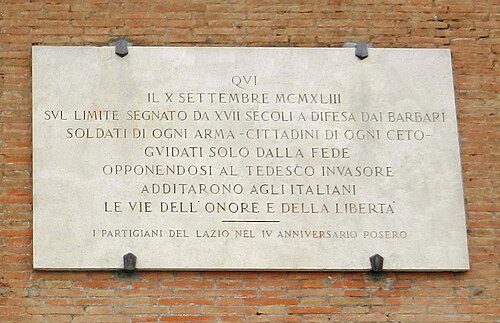


Some places, as Jewiss showed, contain multiple layers of history. A single site may gather several plaques, monuments, or inscriptions, each connected to different moments and groups. Jewiss discussed how one plaque can create links across very different historical moments: Ancient Rome, the Resistance fighters of 10 September 1943, the forces of the Risorgimento, and the political violence and terrorism of the 1970s and 1980s. Such an inscription constructs a genealogy of resistance, placing different struggles into relation with one another across time. This connection can be powerful but at the same time, it raises questions about how memory is organized: which events are brought together and what kind of national narrative is produced through these links?
This also has a performative dimension. In the discussion after the talk, Jewiss pointed out that historical sites and memorial backgrounds are often used in political speeches and public ceremonies. When political figures speak in front of a plaque or another memorial object, they position themselves within the history represented by that place. They do not simply refer to the past; they use the past to create meaning in the present. In doing so, they may align themselves with a particular tradition, claim continuity with earlier struggles, or attempt to produce a new historical moment. Memory, then, is not only preserved in public space. It is performed there.
By reading plaques as carefully as literary texts, Jewiss demonstrated how much meaning can be contained in a few words carved into stone or metal. These small inscriptions, she suggested, do not merely recall past events; they also help us understand the social and political questions that continue to shape the present.