
The CIMS Postgraduate Masterclasses offer postgraduate students the opportunity to engage closely with leading scholars working in the fields of cultural identity and memory studies. Each masterclass is structured around a presentation by the invited scholar, who introduces key concepts, methodological approaches, or current research questions.
In advance of the session, participants are asked to prepare a short reading selected by the speaker. The masterclass itself combines discussion of this reading with guided questions and open exchange, creating space for critical engagement and dialogue. The format is designed to encourage active participation and to support postgraduate researchers in reflecting on how the approaches discussed might inform their own work.
Upcoming Masterclass
Our Candlemas 2026 masterclass has already taken place. We will share details about our next upcoming masterclass here as soon as possible, so please check back soon.
Past Masterclasses
February 27, 2026
Professor Jenny Wüstenberg: Masterclass on Slow Memory
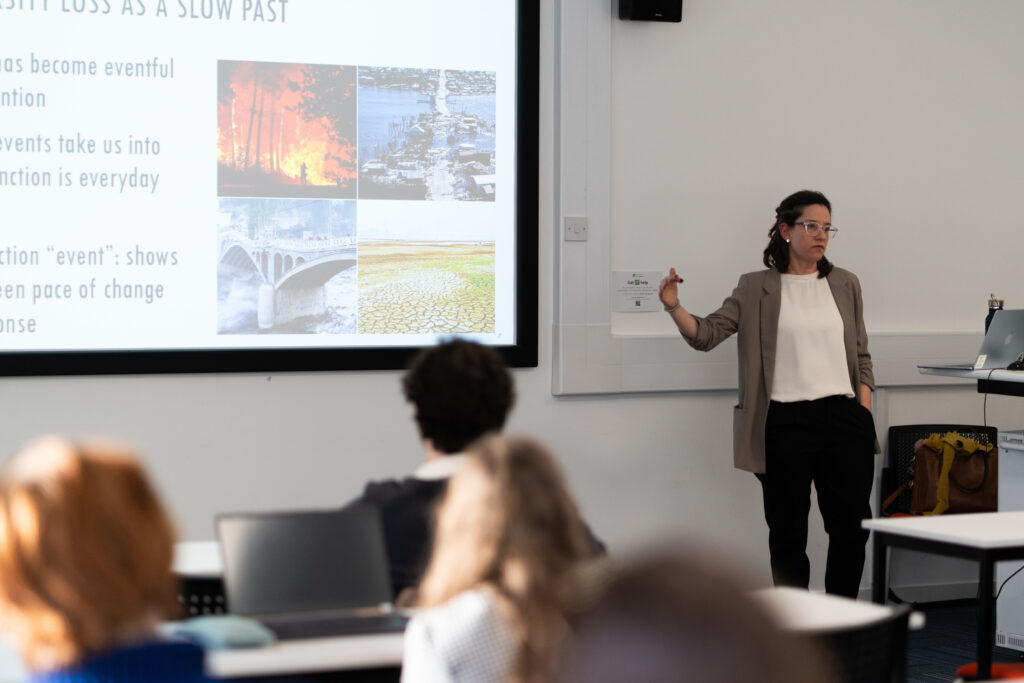
On 27 February 2026, our postgraduate community welcomed Professor Jenny Wüstenberg (Nottingham Trent University) for a masterclass titled “Slow Memory: Remembering Gradual Change in an Accelerating World.” The talk offered a compelling framework for thinking about why certain kinds of change, so often fail to translate into sustained public attention or policy action, even when their consequences are profound.
Professor Wüstenberg argued that many of today’s most pressing challenges do not announce themselves through sudden catastrophe or decisive turning points. Instead, they unfold in creeping or even invisible ways. This “slowness” of change makes it harder to keep issues in view, while accelerated political, economic, and media rhythms further undermine sustained attention and long-term policy response. Slow memory, in this sense, helps illuminate cases where remembering becomes difficult precisely because the timescales of harm and the timescales of public action do not match.
Two examples anchored the discussion. The first was biodiversity loss, a process that accumulates over time and space rather than appearing as a single event. Because ecological decline often lacks a clear beginning, endpoint, or commemorative “moment,” it can be difficult to narrate and mobilize, despite its seriousness. The second example focused on family separation policies and their enduring effects. Here, the talk highlighted how systemic harm can be legitimized through broad ideologies and institutional routines, implicating whole societies. Even when policies shift, the consequences may persist as intergenerational harm: a “past that will not pass.” Importantly, such harm can be both event-like and placeless: experienced as an ongoing condition rather than something tied to one site or date.

A key takeaway was that slow pasts can be remembered at different speeds, and that the “right” tempo of memory is not obvious in advance. Should societies try to create faster, more attention-grabbing forms of remembrance to spur action? Or should they cultivate slower, sustained modes of engagement?
The masterclass also pointed to the broader work around slow memory beyond the talk itself. Professor Wüstenberg’s research network shares outputs in multiple formats on their website, including podcasts, a Spotify playlist, an exhibition, and even a cookbook, expanding the idea of memory work into creative and everyday practices.
November 9, 2024
Professor Emma Bond: Masterclass on Working Comparatively in Modern Languages
On November 9th, Professor Emma Bond led a masterclass on “Working Comparatively in Modern Languages,” offering a timely reflection on a methodological skill that is increasingly central to contemporary research in the field. Held at Buchanan 305, the session brought together postgraduate researchers interested in comparative approaches that move across languages, literatures, and cultural contexts.
In the first part of the masterclass, Professor Bond reflected on her own experiences of working comparatively, emphasizing comparison not as a static method of placing texts side by side, but as an intellectual practice that reshapes research questions and disciplinary boundaries. This was followed by a lively discussion, in which participants engaged with questions of the practical challenges of comparative research.
The second part of the session was structured around sharing participants’ own modes of working comparatively. Postgraduate researchers discussed projects that cross linguistic, national, and medial boundaries, reflecting on how comparison operates not only between objects of study, but also within research practices themselves.
Emma Bond is Professor of Italian and Comparative Studies at the University of Oxford and Honorary Professor in the School of Modern Languages. Her research is situated at the intersection of comparative literature, transnational studies, and cultural theory, with a sustained focus on migration, borders, memory, and the body.
March 18, 2024
Professor Michele Monserrati: Masterclass on Environmental Humanities
On Monday the 18th, CIMS hosted its first Postgraduate Masterclass with a focus on Environmental Humanities. The session brought together postgraduate researchers from across the School for an intensive exploration of environmental humanities as a field, a methodology, and a way of rethinking established disciplinary boundaries.
The masterclass was led by Professor Michele Monserrati, a scholar of Modern Italian Studies whose work spans diaspora studies, mobility, and environmental humanities. His research examines the cultural formation of Italian spaces and communities beyond the peninsula, asking how these transnational contexts reshape understandings of Italian culture and its position within global histories. His most recent monograph, “Searching for Japan: 20th Century Italy’s Fascination with Japanese Culture” (Liverpool University Press, 2020), explores how Italy’s engagement with Japan was shaped by a shared sense of being a latecomer to modernity, generating a distinctive fascination with alternative models of nation-building and imperial formation.
Rather than offering a fixed definition of the environmental humanities, Professor Monserrati approached the field as a dynamic and open-ended mode of inquiry. He reflected on how environmental questions intersect with migration, empire, and cultural memory, and how environmental humanities research often emerges from tensions between literary analysis, historical perspectives, and contemporary political concerns. This approach encouraged participants to think of the environment not as a background or setting, but as a central analytical category that reshapes how spaces and communities are understood.
The session was structured as an interactive conversation, with postgraduate students invited to raise questions, share perspectives from their own research, and reflect on how environmental humanities might intersect with their disciplinary training.