8 October 2025, 13.00-14.00, Buchanan 215
Kristen Treen
U.S. Civil War Monuments: Forms, Feelings, Futures
This talk will introduce the rationale behind Commemorative Cultures: The U.S. Civil War Monuments Project, a collaborative digital heritage project I run from within the School of English, via a discussion of literary responses to some of the Civil War’s (1861-1865) first monuments and early theorisations of monumental function, especially in the victorious northern states. Monuments to the southern Confederacy’s ‘Lost Cause’ have dominated debates about the place of Civil War monuments in contemporary public spaces, and widespread condemnation of the white supremacist values such objects preserve and perpetuate has inflected scattered discussions of the North’s monuments, which have critiqued the pitfalls of monuments to Emancipation and the uses of monuments to Union as tools for social control. This talk will think with and around Gary Yongue’s assertion that public monuments are ‘among the most fundamentally conservative […] expressions of public art’, and seek to challenge some of the assumptions attendant on monumental forms and the feelings they inspire, by dwelling on poet Emily Dickinson’s responses to a curious monument dedicated early on in the war, in Amherst Massachusetts. Plumbing the intimate affective response Dickinson experiences when faced with one of the first monuments to the Civil War, I’ll explore the northern Civil War monument’s status as a potent site of subjective and mnemonic transformation, and ask what Dickinson’s personal encounter with the monument as a dynamic, rhetorically-constituted object might mean for attempts to interpret and manage Civil War monuments today.
5 November 2025, 13.00-14.00, Buchanan 215.
Abigail Karas
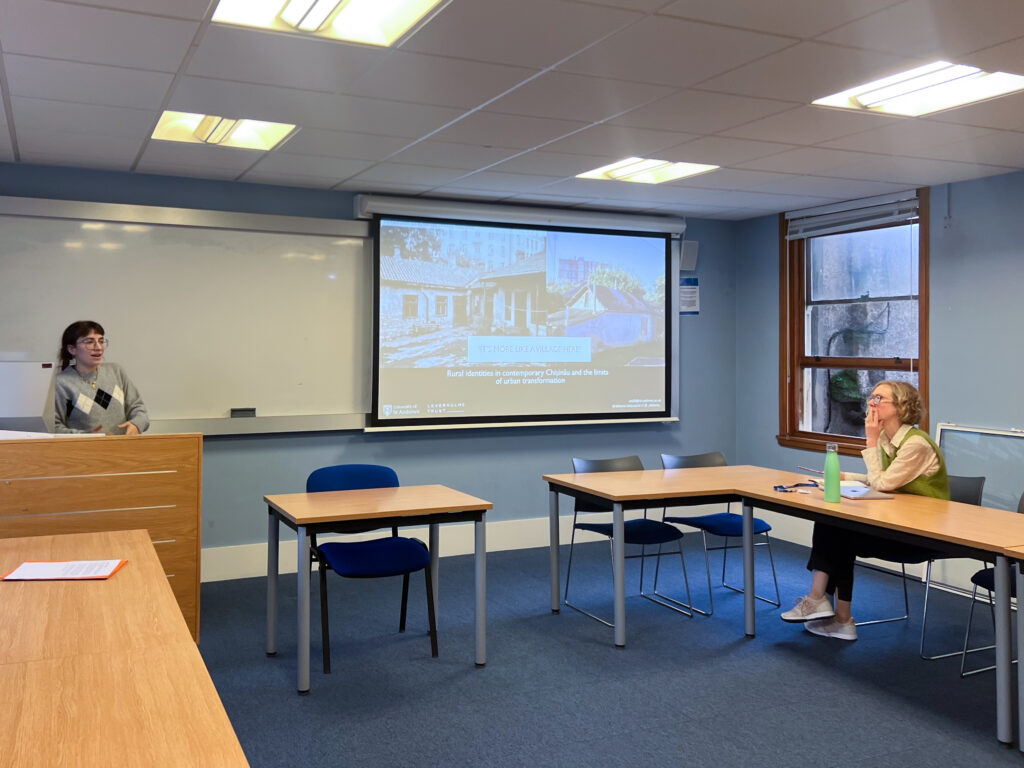
“It’s more like a village here”: Rural identities in contemporary Chișinău and the limits of urban transformation
Dr. Abigail Karas is an anthropologist and historian of the built environment, with a particular focus on (post-)Soviet cityscapes. Her work moves seamlessly across disciplines, drawing on anthropology, urban history, heritage, and cultural studies to explore how space and identity interact in the shifting landscapes of the post-socialist world.
Her current research investigates how national and civic identities have been constructed in the Republic of Moldova since its independence from the Soviet Union looking in particular at how architecture and urban planning have been used to express ideas of Moldovan nationhood, and how citizens respond to and reshape these visions in their everyday environments.
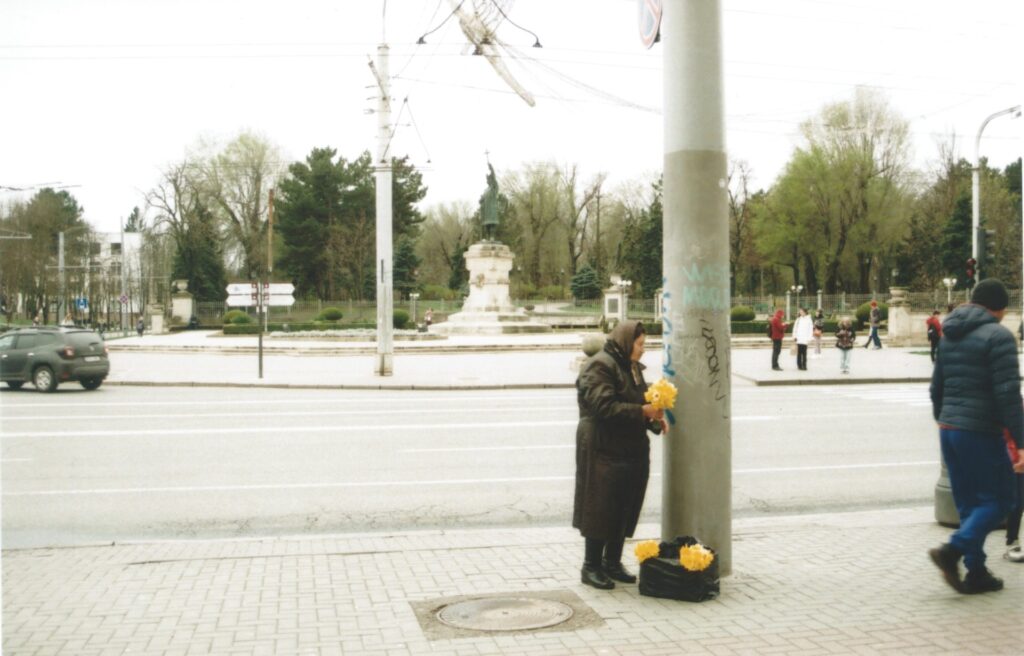
In her talk she examines the concept of “ruralization” in Chișinău, the capital of the Republic of Moldova. By challenging conventional narratives of urbanization as a unilinear process, it argues that rural identities and practices persist and are reasserted within Chișinău’s urban spaces, blurring the urban-rural boundary. This hybridity, influenced by Moldova’s complex history under various imperial rules, is evident in vernacular architecture, subsistence practices, and a cultural valorization of the village as a core national identity marker. The talk contends that Chișinău’s “urban rurality” offers an alternative vision of urban life, resisting teleological models of modernity and fostering a unique socio-spatial landscape.
18 February 2026, 13.00-14.00, UCO: 30
Kamila Oles
Memory Crafted in Glass and Stone:
The Polish Soldiers’ Mosaic in St Andrews as a Material Representation of Collective and Mediated Memory
The “Scotland’s Future – Collective Memories in Fostering Unity” project traces shared Scottish–Polish heritage. This lecture, by examining the mosaic as both an artwork and a memory object, invites audiences to explore a lesser-known yet compelling chapter within this history: the story of three young Polish paratroopers who studied at the University of St Andrews during the Second World War. Trained as members of the Polish Section of the British Special Operations Executive (“Silent Unseen”), they combined military skill with remarkable artistic talent, creating a mosaic in Edinburgh that was later installed on the façade of St Andrews Town Hall. Offered as a gesture of gratitude to the town that welcomed and supported them, the mosaic remains one of the most evocative material witnesses to the wartime presence of the Polish Allied Forces in Scotland.
In the decades that followed, when many former soldiers could not publicly acknowledge their identities under communist persecution, the mosaic acquired new meaning. What began as a wartime token of appreciation gradually became a powerful symbol of collective and mediated memory, silently connecting those whose stories could not be spoken aloud. Across generations, it has functioned as a site of remembrance, commemoration, and quiet resistance, preserving bonds between Scotland and the Polish diaspora. The lecture concludes by reflecting on how this mosaic continues to animate public memory, sustain intergenerational bonds, and shape local identity in St Andrews, demonstrating how material culture can hold the past open within the present.
Dr Kamila Oles is an research fellow at the School of English. She is an art historian, archaeologist, and curator specialising in 3D digitisation, advanced digital art history, inclusive and co-curatorial exhibition design, contested memory, art diplomacy, and digital heritage engagement. Her current research focuses on visual language and co-curation of contested memories, working with descendants of African American US Civil War soldiers at Camp Nelson National Monument (Kentucky) while collaborating with National Parks of America Camp Nelson National Monument museum refit and with British descendants of Polish soldiers from the WW2, examining heritage and art as collective and mediated transmitters of memory and inherited trauma.
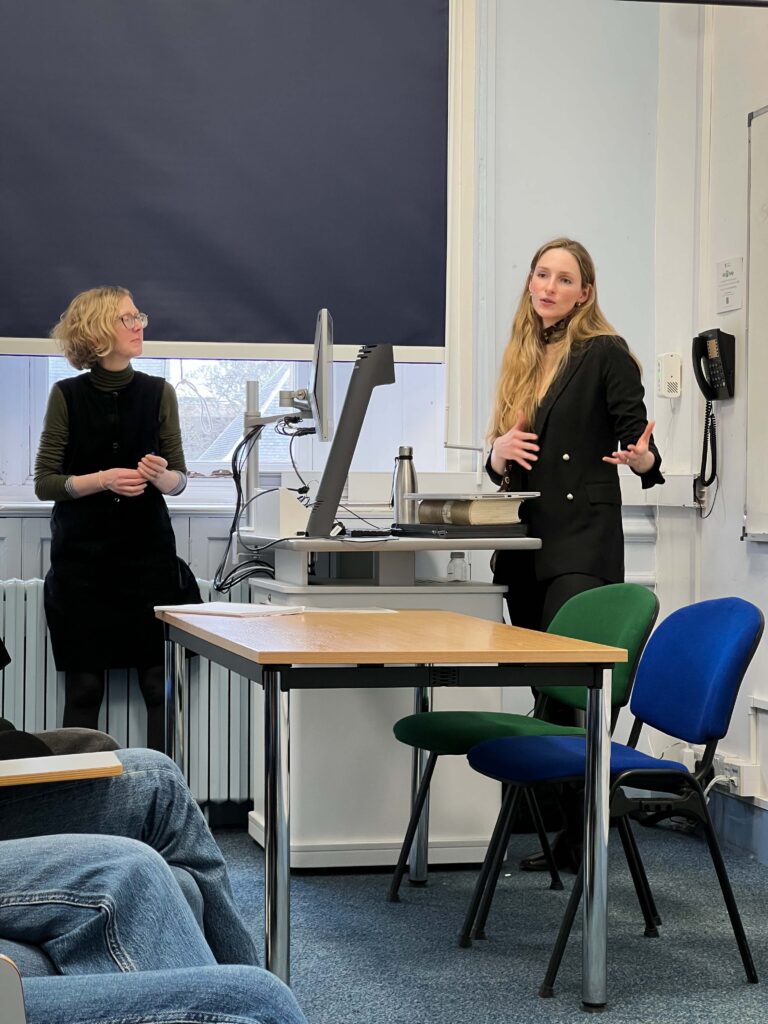

11 March 2026, 14.00-15.00, UCO: 30
Lydia Maria Roth
“We created a new memory culture”: Remembering the victims of right-wing terror in Hanau
Lydia Maria Roth discussed how remembrance practices surrounding the 2020 right-wing terrorist attack in Hanau have changed in the years since the event. Referring to a statement by survivor Said Etris Hashemi from 2025 “In Hanau, we created a new memory culture. Previously, the perpetrator was the focus. Now it is those who died.” Roth explored how those affected by the attack have actively worked to shift public attention toward the victims.
Placing Hanau in the broader context of right-wing terror in Germany since the early 1990s, Roth highlighted that public discourse has often centered on perpetrators rather than victims. In Hanau, however, families, friends, and survivors have played a central role in reshaping this pattern. Through initiatives such as Initiative 19. Februar Hanau, they have created spaces of solidarity, supported those dealing with bureaucratic consequences of the attack, and raised awareness about racism and recurring patterns of right-wing violence in Germany.
Roth also emphasized the role of supportive institutions. For example, the football club Eintracht Frankfurt joined the campaign #SayTheirNames on the first anniversary of the attack and helped preserve the memorial mural located in Frankfurt by financing a protective sealing.
During the discussion, cultural initiatives that continue to raise awareness were mentioned, such as the reading tour of “Born, Raised and Murdered in Germany”, which visited several universities in the United Kingdom in October 2025, including the University of St Andrews.

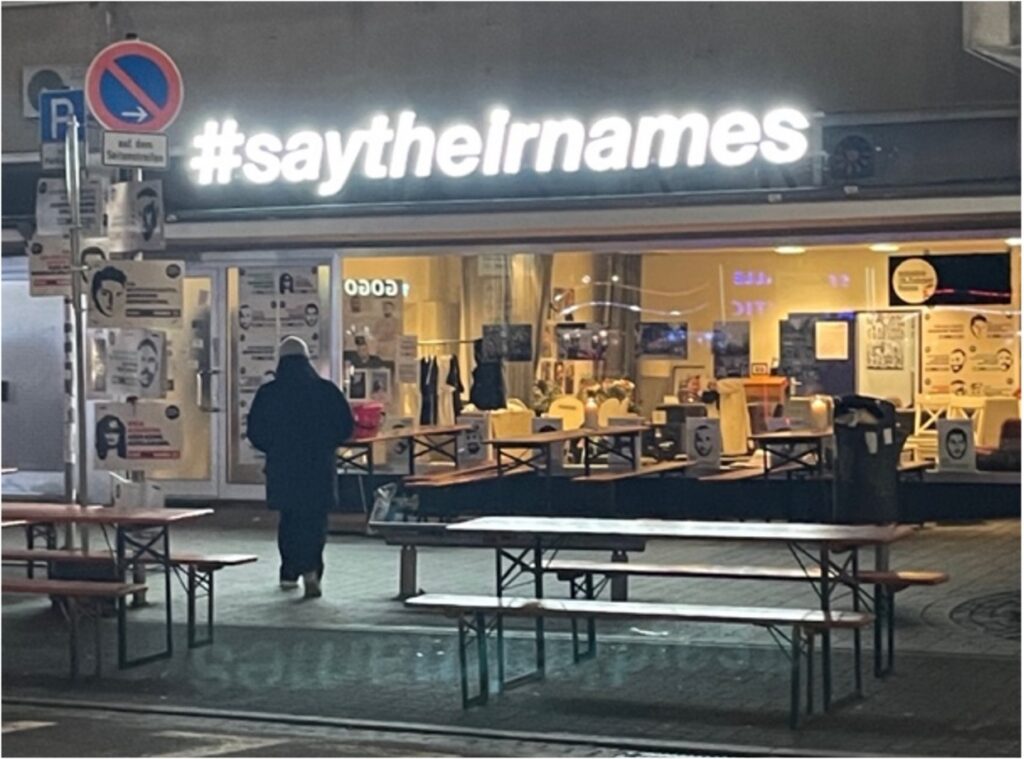
© Lydia Maria Roth